
Scoliosis is a spinal condition, but its effects aren’t isolated to the spine; scoliosis can also affect the spine’s surrounding muscles, nerves, and the entire body. As a progressive condition, it’s important to understand that symptoms can increase over time.
Scoliosis introduces a lot of uneven forces to the spine and body. Particularly common with thoracic scoliosis, a rib flare can develop where one side of the rib cage protrudes more than the other side; this is due to the spine’s unnatural bend and twist pulling on the rib cage.
The best way to minimize the potential effects of scoliosis, including the development of a rib flare, is to treat conditions proactively.
Common Scoliosis Symptoms
When it comes to scoliosis symptoms, no two cases are the same; scoliosis ranges widely in severity from mild scoliosis to moderate and severe scoliosis.
In most cases, the more severe a condition is, the more noticeable its symptoms are going to be.
In mild cases, it can be difficult to diagnose scoliosis because the symptoms are subtle, and despite the potential benefits of early detection, it can be a challenge to achieve.
There are no treatment guarantees, but the earlier conditions are diagnosed and treated, the more responsive they tend to be.
As a progressive condition, the nature of scoliosis is to get worse over time, and this means the unnatural spinal curve is increasing in size, along with its rotation, and related symptoms.
It’s important to understand that in addition to ranging widely in severity, scoliosis also affects all ages, and there are different types of scoliosis, determined by various causes.
The most prevalent type overall is adolescent idiopathic scoliosis diagnosed during adolescence, and this age group is the most at risk for rapid advancement of the curve because it’s growth that triggers progression.
When it comes to treating childhood scoliosis, it’s particularly important how conditions are managed during periods of rapid growth, which characterizes puberty.
A rib flare is most common in cases of thoracic scoliosis.
Thoracic Scoliosis and Rib Flare
The spine can be divided into three main sections that work together to facilitate its balance and function.
The cervical spine refers to the neck; the thoracic spine includes the middle/upper back, and the lumbar spine refers to the lower back.
Each spinal section has unique roles to play in maintaining overall spinal health.
The cervical spine has to support the weight of the head and allow for a wide range of motion in the neck, and the lumbar spine has to support the weight of the spinal sections above, the upper body, and its vertebral bodies feel the strain of bending, lifting, twisting, and a number of strenuous movements.
The thoracic spine is the largest spinal section, and as the only section attached to the rib cage, it can directly affect its position.
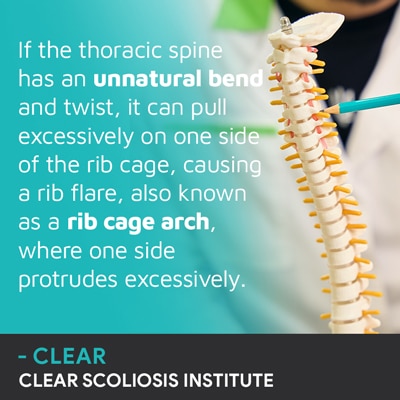
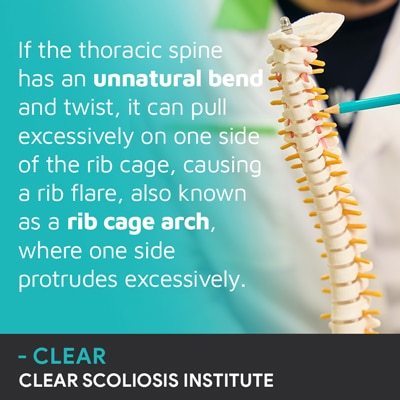 If the thoracic spine has an unnatural bend and twist, it can pull excessively on one side of the rib cage, causing a rib flare, also known as a rib cage arch and/or a rib hump, where one side protrudes excessively.
As a 3-dimensional condition, scoliosis involves rotation, and the more rotation there is, the more overtly the rib cage can be affected.
Scoliosis is an asymmetrical condition, and most asymmetries, including a rib flare, are most noticeable when in a forward bend position, which is why an Adam’s forward bend test is the most commonly used screening examination.
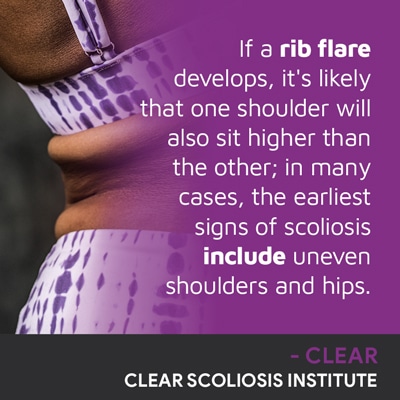 If a rib flare develops, it’s likely that one shoulder will also sit higher than the other; in many cases, the earliest signs of scoliosis include uneven shoulders and hips.
Is a Rib Flare Painful?
Not all postural asymmetries are painful, particularly in young patients who are still growing, so not all scoliosis patients will experience pain.
Although there are multiple factors that shape a patient’s level of pain, compression is primary, and scoliosis becomes a compressive condition once skeletal maturity is reached.
When patients are still growing, the constant lengthening motion of growth counteracts the compressive force of the spine’s unnatural bend and twist, but once growth stops, there is nowhere for that force to go, and pain becomes a common symptom.
In fact, pain is the main symptom of adult scoliosis.
So whether or not a rib flare is painful will depend on a number of factors including patient age, angle of trunk rotation, and scoliosis severity.
Patients most likely to experience chest and rib pain include adult patients with severe scoliosis and a high angle of trunk rotation.
If thoracic scoliosis is left untreated and a rib flare worsens alongside progression, mobility issues and complications can develop.
One of the roles of the thoracic spine is to protect the lungs and heart, so if the spinal section is unhealthy and compressing important organs, it can become problematic.
Lung impairment isn’t always noticeable, but for some patients, a severe rib flare can cause less room for the lungs to function optimally within, and for athletes, this can make taking a deep breath challenging.
Breathing issues aren’t considered a common symptom of scoliosis, but when severe, and particularly in atypical cases that involve left-bending curves, breathing can also develop.
Additional complications of untreated severe scoliosis include digestive issues, migraines, and the need for invasive surgical treatment.
The key to preventing increasing symptoms related to progression is to treat scoliosis proactively.
Proactive Scoliosis Treatment
Proactive scoliosis treatment is started as close to the time of diagnosis as possible because as a progressive condition, its nature is to become more severe and complex to treat.
As scoliosis progresses, the spine can become increasingly rigid, making it less responsive to treatment, and particularly with older patients who have experienced a significant amount of progression prior to their diagnosis, a rigid spine can interfere with the ability to perform therapeutic exercises as part of treatment.
So starting treatment while the spine is going to be at its most flexible because conditions are also at their mildest, means a spine that’s flexible and more likely to respond well.
Proactive scoliosis treatment works towards prevention: preventing progression, increasing condition effects, and the need for more invasive forms of treatment.
Here at the Atl anta Scoliosis Center, the goal is to restore as much of the spine’s healthy curves as possible, good posture, and improve the spine’s balance and stability through nonsurgical treatment.
Nonsurgical scoliosis treatment is modern, innovative, and integrative, and combines multiple treatment modalities for the best potential outcome.
Scoliosis-specific chiropractic care can work towards adjusting the position of the most unnaturally tilted vertebrae at the curve’s apex, and scoliosis-specific physical therapy addresses the spine’s surrounding muscle health.
Physical therapy focuses on increasing the spine’s surrounding muscle balance and strength for more spinal support and stability.
Corrective bracing, when deemed appropriate, can further improve the spine’s alignment by placing the spine in an over-corrective position. As growing spines are more malleable and responsive to bracing, it’s a common facet of childhood scoliosis treatment.
Conclusion
A rib flare is most commonly a sign of thoracic scoliosis because the thoracic spine is the only spinal section that attaches to the rib cage; it’s caused by the unnatural spinal curve’s pulling excessively on one side of the rib cage.
A rib flare will increase with progression and rotation; the more rotation in the spine, the more noticeable a rib arch can become, but flared ribs can improve with a customized treatment plan that works to reduce the unhealthy curve and improve core strength for more support.
The best way to prevent postural asymmetries from increasing is to treat conditions proactively.
Here at CLEAR, patients benefit from a proactive chiropractic-centered treatment approach that combines the corrective potential of scoliosis-specific chiropractic care, physical therapy, and bracing.
The best treatment for scoliosis is going to be proactive because it means working towards counteracting the condition’s progressive nature.
The post What Causes Rib Flare? Causes and Solutions Explained appeared first on Atl anta Scoliosis Center.