
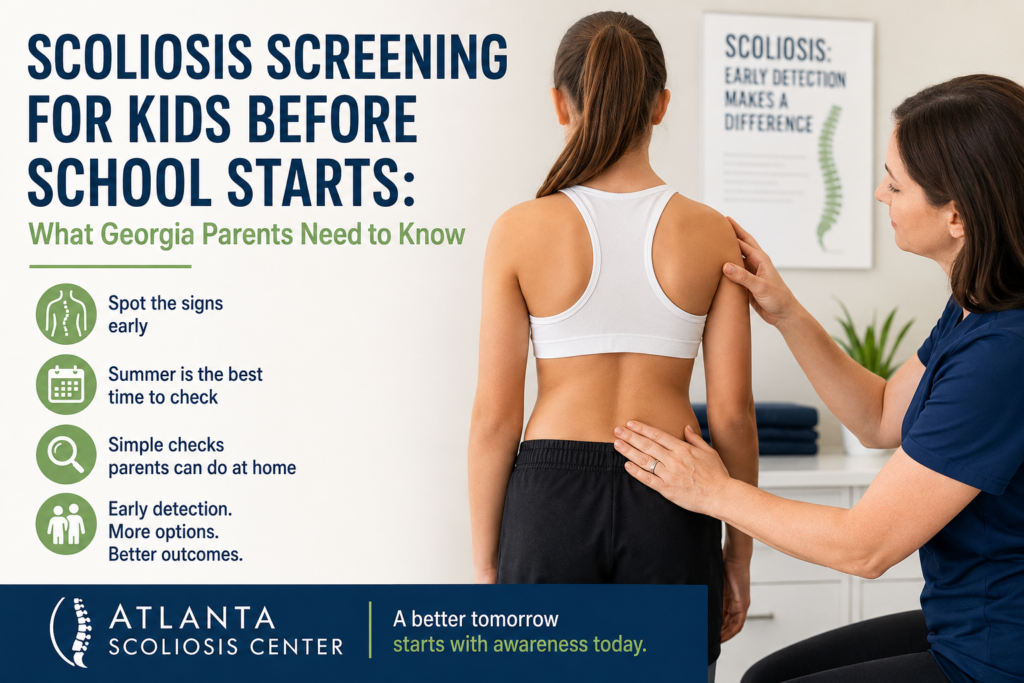
Every July, the same thing happens in our office. A parent calls and says some version of: “I was helping my daughter try on school clothes, and something about her shoulders looked… off.”
Back-to-school season is when Georgia parents finally get a good, long look at their kids. Swimsuits, new clothes, haircuts, and time spent together can make subtle posture changes easier to notice.
If that sounds familiar, this post is for you. Here’s what a scoliosis screening for kids actually involves, the signs worth checking for at home, and when it’s time to bring your child in, ideally before the school-year chaos starts in August.
Why Summer Is the Right Time for a Scoliosis Screening for Kids
Scoliosis is most commonly diagnosed between ages 10 and 15, and there’s a reason for that: growth.
Scoliosis is a progressive condition, and periods of rapid growth can increase the risk of curve progression. A curve that’s barely noticeable in May may look different several months later as a child grows.
There’s a practical reason to pay attention at home, too. School scoliosis screening practices can vary, so parents shouldn’t assume a school screening will catch a developing spinal curve.
That leaves the first line of detection where it has always really been: at home, with a parent paying attention.
You’ve heard the old saying that an ounce of prevention is worth a pound of cure. With scoliosis, early detection can make a meaningful difference. Smaller curves identified during childhood may provide more opportunities for proactive treatment and monitoring than curves discovered after significant progression.
Scoliosis Fact
About 80 percent of scoliosis cases are considered idiopathic, meaning there is no single known cause. Childhood scoliosis can also develop without significant pain. That’s one reason it can go unnoticed. A child may not complain because nothing hurts.
Signs of Scoliosis in Children: What to Look For at Home
You don’t need medical training to do a basic posture check.
Have your child stand relaxed with their feet together and arms at their sides. A bare back or fitted shirt will make changes in posture easier to see.
Look for:
- One shoulder sitting higher than the other
- One shoulder blade sticking out more than the other
- An uneven waistline or one hip that looks higher
- The head not centered directly over the body
- A visible lean to one side
- Clothes hanging unevenly, such as a neckline pulling to one side or one pant leg appearing longer
Then try a forward bend check, a test commonly used during scoliosis screenings.
Have your child bend forward at the waist with their arms hanging down, similar to touching their toes. Stand behind them and look across the back. If one side of the rib cage or lower back appears higher than the other, it may indicate the spinal rotation associated with scoliosis.
Spine Specialist Insight
The forward bend test can reveal changes that aren’t as obvious when a child is standing. Scoliosis doesn’t simply cause the spine to curve sideways. It can also involve spinal rotation, which may become more noticeable when the child bends forward.
There’s one more thing parents can check that has nothing to do with looking directly at the spine: shoes.
If one heel consistently wears down differently than the other, mention it during your child’s evaluation. Uneven shoe wear can sometimes accompany differences in posture or gait and may be worth discussing with a professional.
When to Get Your Child Checked for Scoliosis
If you’ve noticed a postural change clearly enough that you’re concerned about it, getting it checked can provide valuable answers.
Sometimes an evaluation confirms that everything is fine. Other times, it identifies a spinal curve while there is still significant growth ahead and an opportunity to address it proactively.
Consider scheduling a professional scoliosis screening if:
- You spotted any of the signs above, even if they seem mild
- Your child is between 10 and 15 and is going through a period of rapid growth
- Scoliosis runs in your family
- A pediatrician, coach, physical therapist, or school nurse has mentioned your child’s posture
- Your child was screened previously but has grown significantly since that evaluation
Scoliosis Fact
A scoliosis diagnosis involves an abnormal sideways spinal curve measuring 10 degrees or more using the Cobb angle measurement on an X-ray.
That measurement helps separate a visual concern during a screening from an actual scoliosis diagnosis. It also helps determine the severity of the curve and provides a baseline for monitoring changes over time.
What Happens at a Professional Scoliosis Screening?
A professional scoliosis evaluation can go further than the quick posture check performed at home, school, or during a routine physical.
At Atlanta Scoliosis Center, a pediatric scoliosis evaluation can include a detailed postural assessment, forward bend testing, and, when clinically appropriate, standing X-rays and Cobb angle measurements.
The goal is to understand what your child’s spine is doing rather than relying on guesswork.
If a curve is identified, the next step depends on several factors, including the size and location of the curve, your child’s age, remaining growth, symptoms, and risk of progression.
Depending on the individual case, proactive scoliosis care may include scoliosis-specific chiropractic care, targeted exercises, monitoring, and corrective bracing when appropriate.
The important part is having enough information to make an informed decision about what comes next.
Spine Specialist Insight
Parents often wish they had noticed their child’s scoliosis sooner. Early evaluation can provide something extremely valuable: information.
Once you understand the curve’s size, location, and potential for progression, you can make informed decisions about monitoring and treatment rather than wondering what might be happening.
A 10-Minute Back-to-School Scoliosis Checklist for Parents
Before the first day of school, take ten minutes and run through this simple checklist:
- Check your child’s standing posture, including the shoulders, shoulder blades, waist, hips, and head position
- Try the forward bend test and look for unevenness in the ribs or lower back
- Check shoe heels for noticeably uneven wear
- Ask whether your child experiences recurring back discomfort, fatigue, or tightness
- Pay attention to whether shirts, dresses, or pants suddenly seem to hang unevenly
- If something looks or feels unusual, schedule a professional screening rather than simply waiting for the next annual physical
From the Treatment Room
Backpacks don’t cause scoliosis. However, carrying an excessively heavy backpack or regularly carrying a bag over one shoulder can contribute to discomfort, particularly for a child who already has muscular imbalance or an existing spinal curve.
Using both backpack straps and keeping the load reasonable remains a good habit for growing kids.
Caught Early, Scoliosis Is More Manageable
Finding scoliosis early can provide more options for monitoring and treatment while a child is still growing.
The challenge is that scoliosis can progress quietly. A child may feel perfectly healthy while subtle changes in shoulder height, waist symmetry, or posture gradually become more noticeable.
That’s why a simple back-to-school posture check can be worthwhile.
It takes about ten minutes. Look at the shoulders. Check the waist and hips. Try the forward bend test. Pay attention to how clothes fit and whether anything has changed since the last growth spurt.
If you see something that doesn’t look quite right, don’t rely on guesswork.
Schedule a scoliosis screening with Atlanta Scoliosis Center and find out what’s happening with your child’s spine before another growth spurt passes.
FAQs
What is the best age for a scoliosis screening for kids? The best window for a scoliosis screening for kids is ages 10 to 15, when adolescent growth spurts drive curve progression and screenings should repeat through those years, not happen just once. That said, scoliosis can appear earlier, so any visible sign at any age deserves a check.
My child’s screening found a small curve. Does that mean bracing or surgery? Not at all. Small curves caught early have the most treatment options, and most never need surgery. Depending on the curve’s size and your child’s growth stage, treatment may involve scoliosis-specific chiropractic care and exercises, with corrective bracing only when the case calls for it. The point of early screening is exactly this: more options, less drastic ones.