
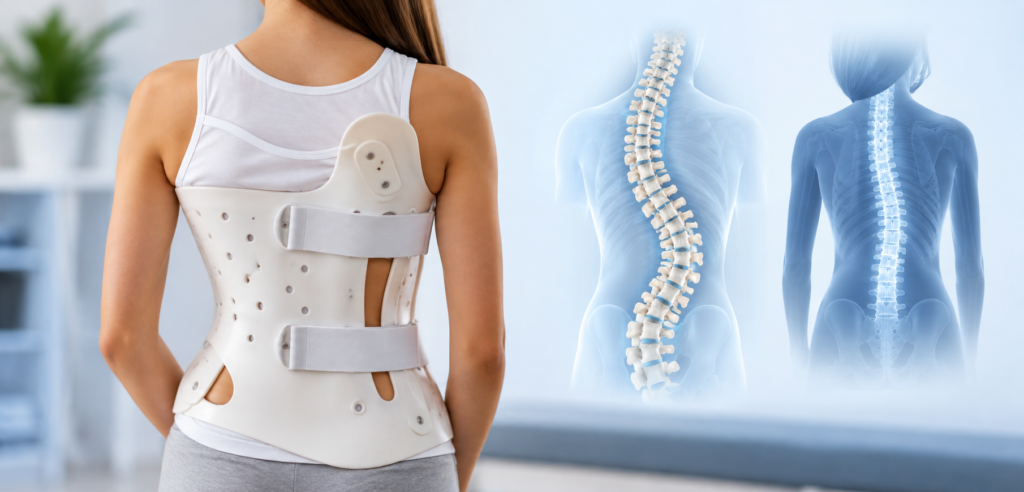
Almost everything written about scoliosis bracing stops at the fitting.
You get scanned, you pick a pattern, the brace arrives, someone shows you how to strap it. The articles end there, as though the brace were a pair of glasses. Put them on, done.
That is not how it goes. A scoliosis brace adjustment is not a rare event for when something breaks. It’s the normal rhythm of treatment, and the first year involves more of them than most families expect. Here’s what actually happens after you walk out with it.
The First Change Is Almost Always the Armpits
The very first modification is usually not about correction at all. It’s about survival.
New braces tend to sit aggressively under the arms. So the first adjustment is often cutting down the area around the armpits, so the brace isn’t too harsh right at the start. A brace that hurts on day three is a brace that ends up in a closet by week two, and a brace in a closet corrects nothing.
That’s the quiet math of bracing. The most sophisticated design in the world does nothing if it isn’t worn, so early adjustments are about buying compliance.
Every Three Months, Whether Anything Feels Wrong or Not
After the initial evaluation, we schedule brace evaluations every three months.
Not only when something hurts. Not only when a parent calls. On a schedule, because bodies change faster than anyone notices from the inside, and a brace that fit perfectly in March can be doing significantly less by June without ever feeling different.
Kids grow. Adults change posture, weight, and muscle tone. And when treatment is working, the shape it was molded to isn’t the shape it’s holding anymore.
Why the Brace Usually Gets Tighter, Not Looser
Here is the part that surprises families most.
If a patient wears the brace consistently, it often needs to be adjusted so it can be pulled tighter. Not because anything went wrong. Because the body responded, the tissue gave, and the brace now has slack it didn’t have when it was molded.
Parents sometimes hear “we need to take it in” and assume it’s bad news. It’s the opposite. A brace that never needs taking in is usually a brace that isn’t being worn enough.
| The Tighter the Better: If your child’s brace suddenly feels loose or shifts more than it used to, don’t wait for the next scheduled visit to mention it. That looseness is often evidence the brace is doing its job, and it’s also the moment it starts doing less. Call and get it taken in. |
The Bench in the Back Room
Most bracing providers send modifications out. The brace goes in a box, it goes somewhere, and you wait.
Ours don’t leave the building. Every adjustment happens at a pegboard workbench in the back of our Newnan office, and Dr. John does all of them himself. That’s the detail families are most surprised by, and it’s the one that changes the experience most.
The practical effect: many modifications happen the same day you come in. If the schedule is full, you drop the brace off and pick it up the next day. Not next month, and not after a shipping label and a phone tree.
Few practices in this region match Atlanta Scoliosis Center’s approach to in-house brace modification, and it shows in the thing patients actually care about, which is how long they have to tolerate a brace that doesn’t feel right.
What This Means for a Rubbing Brace
A hot spot, a red mark that doesn’t fade, a strap digging in a new place. These are not things to endure until the next appointment.
They’re also not things to solve at home with padding, tape, or a folded washcloth, which almost every family tries at some point. Padding a pressure point can change where the brace loads the spine, which quietly undoes the correction it was built for.
Call instead. A trim or a strap change usually takes minutes.
Not All Braces Adjust the Same Way
Two braces can both be correct and look nothing alike, because the design follows the curve.
A standard ScoliBrace is one shape. A Kypho brace, built for curves with a rounded upper back, has arm paddles and a raised point in the back that presses on that rounded area to hold the shoulders back. Different structure, different adjustment points, different things that need watching over the first year.
There’s also the Whisper brace, which is lower profile and allows more natural movement. One parent put it better than we could in a review:
“We were also excited that Dr G was able to offer us something called a whisper brace that allows more natural movement and is less bulky than what we had seen on-line. My daughter feels much better about wearing that one and her future treatments.”
Note what she’s describing. Not correction numbers. How her daughter feels about the next year of her life. For a teenager, that’s the whole ballgame, and it’s why brace choice and brace comfort aren’t separate conversations.
| Plain Truth About Outcomes: The single biggest variable in bracing results isn’t the brace. It’s hours worn. Which means comfort, appearance, and how quickly a rubbing spot gets fixed are not soft concerns to sort out after the clinical decisions. For a self-conscious fourteen-year-old, they are the clinical decisions, and treating them that way is what keeps a brace on a body instead of in a closet. |
What You Should Expect From Whoever Braces You
If you’re weighing providers, or already braced somewhere and wondering whether this is normal, the questions worth asking are practical ones.
How often will the fit be re-checked, and is that scheduled or only when I call? Are modifications done in-house or shipped out? What’s the typical turnaround when something rubs? Who physically does the adjustment, and have they seen my x-rays?
The answers vary more than you’d think between practices offering what looks like the same brace. Two providers can fit the identical ScoliBrace and deliver completely different results, because one of them re-checks the fit four times a year and turns repairs around in a day, and the other hands it over and waits for the phone to ring.
None of that shows up in a brochure. It shows up eighteen months later in the x-rays.
The Long Game of a Good Fit
A brace is not a product you receive. It’s a fit that gets maintained, quarter by quarter, for as long as treatment runs. The families who do best are the ones who stop thinking of adjustments as problems and start treating them as the schedule.
If your brace is rubbing, loosening, or just sitting unworn because it never felt right, that’s fixable and usually faster than you expect. Request a consultation and bring the brace with you.
FAQs
What’s the best way to tell if your scoliosis brace needs an adjustment?
Watch for three signals: it feels looser than it did, a red mark stays visible more than about twenty minutes after removal, or you find yourself wearing it less without deciding to. That last one matters most. Reduced wear is usually a comfort problem the wearer hasn’t put into words yet.
Can a scoliosis brace be adjusted as a child grows, or do they need a new one?
Many changes are handled through modification rather than replacement, which is why regular fit checks matter so much. Significant growth eventually calls for a new brace, but a lot of families replace sooner than necessary simply because nobody was adjusting the one they had.