
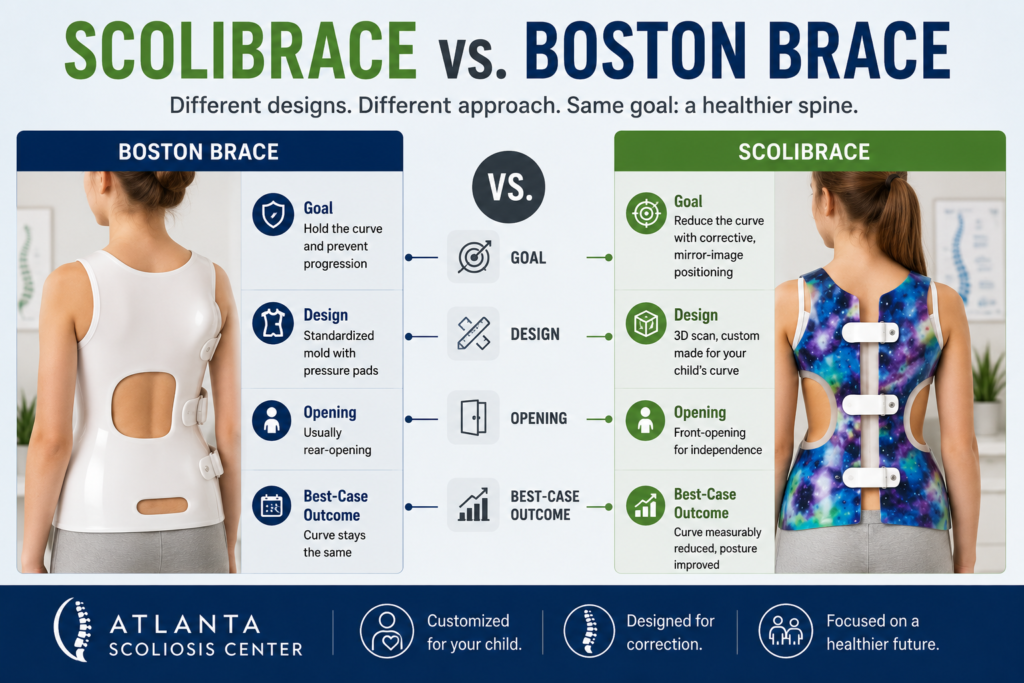
If your child has been prescribed a scoliosis brace, or you’re weighing your options before committing to one, you’ve probably run into the same two names over and over: the Boston brace and ScoliBrace.
When comparing ScoliBrace vs. Boston Brace, one of the biggest differences is the philosophy behind the design. Traditional Boston-style bracing is primarily intended to help prevent curve progression during growth, while ScoliBrace uses a three-dimensional corrective bracing approach designed around the patient’s individual curve pattern.
That difference affects how the brace is made, how it fits, how it applies corrective forces, and what wearing it is like day to day.
Here’s a side-by-side look at the two approaches.
What Traditional Bracing Does: Boston Brace and Similar TLSOs
The Boston brace is one of the most widely used traditional scoliosis braces and belongs to a family of braces called TLSOs, or thoraco-lumbo-sacral orthoses.
It has been used for decades, and its primary purpose is to help prevent a scoliosis curve from progressing while a child or adolescent is still growing.
Traditional braces are generally constructed to apply specific pressure to areas of the torso based on the patient’s curve. Depending on the brace and provider, the fitting process can involve measurements, imaging, scans, or casting, followed by adjustments to create the desired pressure and relief areas.
When worn as prescribed, traditional bracing can be an important tool for managing scoliosis progression during growth.
Why Growth Matters
Bracing is particularly important during adolescence because the spine is still growing.
Periods of rapid growth can increase the risk of scoliosis progression, which is why the timing of a bracing decision can matter just as much as the type of brace selected.
Once skeletal maturity is reached, the goals and potential benefits of bracing can change.
What ScoliBrace Does Differently
ScoliBrace takes a three-dimensional approach to scoliosis bracing.
Rather than relying solely on holding the spine in its existing position, ScoliBrace is designed to apply corrective forces based on the patient’s individual scoliosis pattern and encourage improved spinal and postural alignment while the brace is being worn.
The fitting and design process is also highly customized.
Each ScoliBrace begins with detailed information about the patient, which can include a 3D body scan, X-rays, posture photographs, measurements, and an evaluation of the patient’s individual curve pattern.
This information is used to create a digital model. Computer-aided design and manufacturing technology is then used to produce a brace specifically for that patient.
No two scoliosis curves are exactly alike, so the goal is to create a brace around the individual rather than fitting the individual into a standardized design.
There are practical differences as well.
ScoliBrace uses a front-opening design that can make it easier for many patients to put the brace on and take it off independently. Patients can also choose from different colors and patterns.
That may sound like a minor detail, but it can matter when a child or teenager is expected to wear a brace for many hours.
A brace can only work when it’s worn as prescribed.
Measuring Correction
In-brace X-rays can provide valuable information after a brace has been fitted.
Rather than relying solely on how the brace looks or feels, imaging allows the treatment provider to evaluate what is happening to the spinal curve while the patient is actually wearing the brace.
Those measurements can help guide adjustments and provide families with a clearer understanding of the brace’s effect.
ScoliBrace vs. Boston Brace: Side-by-Side
| Boston Brace / Traditional TLSO | ScoliBrace | |
|---|---|---|
| Primary approach | Help control or prevent curve progression | Three-dimensional corrective bracing |
| Design | Based on the patient’s curve and prescribed pressure/relief areas | Designed around the patient’s individual 3D curve pattern |
| Fitting technology | Varies by provider and brace manufacturer | 3D body scanning, imaging and computer-aided design |
| Customization | Custom-fitted to the patient | Individually designed for the patient’s curve and posture |
| Corrective approach | Applies pressure and relief to manage the curve | Uses 3D corrective forces based on the patient’s curve pattern |
| Opening | Often rear-opening, depending on design | Front-opening |
| Appearance | Varies by manufacturer | Multiple color and pattern options |
| History | Long history of use in scoliosis treatment | Newer generation of 3D corrective bracing |
| Treatment goal | Reduce the risk of progression during growth | Improve alignment while helping manage progression |
| Treatment planning | Typically prescribed as part of scoliosis management | Can be incorporated into a broader scoliosis treatment program |
Is Traditional Bracing Ever the Right Choice?
Yes.
A fair comparison should acknowledge the strengths of traditional scoliosis bracing. Boston-style TLSOs have a long clinical history, are widely available, and are familiar to orthopedic practices and orthotists throughout the country.
For some families, a traditional TLSO may be an appropriate recommendation based on the child’s curve, physician recommendations, insurance coverage, availability, and other individual circumstances.
The more useful question isn’t simply, “Which brace is better?”
It’s, “Which bracing approach makes the most sense for this particular patient’s curve?”
A child may spend months or even years wearing a scoliosis brace. Parents should understand what the brace is designed to accomplish, how correction or progression will be measured, how many hours it needs to be worn, and how it fits into the child’s overall scoliosis treatment plan.
Brace Wear Matters
Following the prescribed wear schedule is an important part of scoliosis bracing.
That’s why comfort, independence, fit, and even appearance can matter. If a brace is difficult to manage or a child strongly resists wearing it, achieving the prescribed wear time can become more challenging.
Those practical considerations deserve a place in the conversation when families compare scoliosis brace options.
Custom Scoliosis Brace Options Beyond the Standard Fit
Custom scoliosis brace options have expanded significantly.
At Atlanta Scoliosis Center, ScoliBrace fittings are available at our Newnan and Alpharetta offices. Bracing can be incorporated into a broader scoliosis treatment plan that may also include scoliosis-specific chiropractic care and targeted exercise based on the patient’s individual needs.
Different bracing approaches may also be considered depending on the patient’s age, curve type, lifestyle, and treatment goals.
Some patients may be candidates for nighttime bracing options. Adults with scoliosis and patients with kyphosis may also have bracing options, although the goals of treatment can differ from those of a growing adolescent.
For a child who is still growing, controlling progression and improving alignment may be important goals. For an adult, bracing may be considered for different reasons, including postural support, stability, function, or symptom management.
Don’t Overlook Your Child’s Role
One of the most important questions parents ask is simple:
“Will my child actually wear the brace?”
That’s an important consideration.
Bring your child to the consultation and involve them in the conversation. Let them see the different brace options, understand why bracing is being recommended, and ask questions.
When a child understands the purpose of the brace and feels involved in the process, following the treatment plan may become easier.
How to Decide Between ScoliBrace and a Boston Brace
Start with an evaluation, not a brace.
The right scoliosis bracing decision depends on several factors, including:
- The size of the curve
- The location and pattern of the curve
- Curve flexibility
- The child’s age
- How much growth remains
- Risk of future progression
- Previous treatment
- Lifestyle and anticipated wear time
- Treatment goals
Imaging and in-brace measurements can also help determine how the spine responds to a particular corrective strategy.
The important thing is not to choose a scoliosis brace based solely on a product name.
Understand your child’s curve first. Then discuss the available bracing approaches, what each is designed to accomplish, and how the results will be measured.
If you’re comparing ScoliBrace vs. Boston Brace for your child, Atlanta Scoliosis Center can evaluate the curve, explain the available bracing options, and help you determine an appropriate next step based on your child’s individual needs.
FAQs
Which is the best scoliosis brace: ScoliBrace vs Boston brace? There’s no single best scoliosis brace for every patient — but the two are built for different jobs. The Boston brace is designed to hold a curve and stop progression; ScoliBrace is designed to reduce the curve using a fully custom, over-corrective design. For growing patients whose curves can still be corrected, a corrective brace makes those brace-wearing hours work harder. The right answer for your child comes from an in-person evaluation and in-brace X-ray measurements.
Can a child switch from a Boston brace to a ScoliBrace? In many cases, yes. If a child is already in a traditional brace and still growing, a scoliosis specialist can evaluate the current curve, review the existing brace’s in-brace correction, and determine whether a custom corrective brace would achieve more. The earlier in the growth window that evaluation happens, the more correction potential remains.