
Our understanding of scoliosis treatment has evolved over the years, and back brace design has kept pace with advanced ultra-corrective designs. When combined with the potential of a scoliosis-specific exercise program and scoliosis-specific chiropractic care, bracing success is more likely.
While traditional scoliosis braces can weaken the spine and its surrounding muscles, the modern and corrective ScoliBrace® is designed to be used in conjunction with movement to maintain muscle and spinal strength.
A general back brace can be used to stabilize the spine after injury, prevent further injury, and reduce pain; back braces for scoliosis are an effective nonsurgical treatment option.
Back Bracing For Scoliosis
A back brace is an orthotic device that’s worn snugly around the torso to support the spine.
Back bracing for scoliosis is a nonsurgical treatment option that is more effective on growing spines and flexible curves, and has the goal of improving the spine’s position and alignment.
In adults, a scoliosis back brace is used more to relieve pain and stabilize the spine for fall prevention, and in children, scoliosis bracing is applied to reduce curve size, manage progression, and has the most potential when it’s used as early intervention; early detection is important.
Scoliosis causes the spine to develop an unnatural lateral spinal curve that also rotates, and as a progressive spinal condition, the nature of scoliosis is to increase in severity over time.
Growth is the main trigger for progression, and age-related spinal degeneration can also trigger scoliosis onset/progression in adults.
When scoliosis develops and progresses, the spine’s alignment is disrupted, further disrupting its balance and stability.
Bracing for scoliosis can help correct an unnatural spinal curve, if it’s corrective; traditional scoliosis bracing can cause muscle weakness and muscle atrophy.
Traditional Scoliosis Bracing
The corrective potential of traditional scoliosis bracing is limited for a number of reasons.
Because scoliosis causes the spine to bend unnaturally and rotate, it’s 3-dimensional and needs to be addressed as such. Traditional standardized scoliosis braces aren’t customized and only address the spine’s unnatural curve, but not its rotation.
Scoliosis is also highly variable with different types, severity levels, curve types, locations, and progressive rates, and bracing, just like overall treatment, needs to be fully customized.
Braces that aren’t customized to address a patient’s specific body and curve type are going to be more bulky and uncomfortable than customized options, and a brace that’s not worn precisely as it’s prescribed is further limited in its potential efficacy; compliance is the main challenge to traditional bracing success.
A brace that’s prescribed for full-time wear can mean up to 23 hours a day, including nighttime.
Considering that the most prevalent type of scoliosis is adolescent idiopathic scoliosis affecting children between the ages of 10 and 18, and this is the age group least likely to comply with wearing a cumbersome brace that changes how they look and move, compliance can be problematic.
The Boston brace is the most popular traditional TLSO (thoracic lumbar sacral orthosis) brace and works towards straightening the spine through 3-point pressure pads that apply squeezing pressure to the spine that, over time, can ultimately weaken the spine.
 As the spine’s surrounding muscles support and stabilize the spine, if a brace is doing the work of holding the spine and torso in an upright position, the back and core muscles aren’t having to work as hard, and over time, can lose strength and endurance.
Modern Corrective Scoliosis Bracing
Modern corrective scoliosis bracing has a different approach and design that preserves back strength and function.
A modern corrective brace like the ScoliBrace® addresses many of the limitations of traditional bracing.
Traditional bracing uses spinal immobilization and isn’t designed to coordinate with a scoliosis-specific exercise program, so the back brace is harder to move in, and patients are also known to experience breathing problems caused by the 3-point pressure pads squeezing the spine and torso excessively.
The ScoliBrace® uses spinal coupling instead of immobilizing the spine, and this allows the brace to be used in conjunction with scoliosis-specific physical therapy.
Combining bracing with exercise preserves core and back muscle strength and prevents muscle atrophy. Wearing a back brace doesn’t have to weaken the spine and back, but if a traditional brace that uses spinal immobilization and doesn’t work well with movement is prescribed for full-time wear, spinal muscles can become weak through lack of use for long periods of time.
The ultracorrective ScoliBrace® works by pushing the spine, rather than squeezing it excessively, into a straighter alignment, and because the brace is designed for 3-dimensional correction, it also addresses the spine’s rotational component.
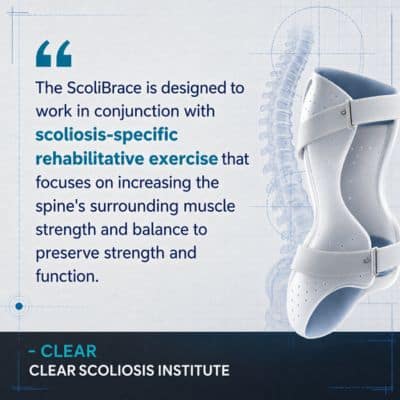 The ScoliBrace® is designed to work in conjunction with scoliosis-specific rehabilitative exercise that focuses on increasing the spine’s surrounding muscle strength and balance to preserve strength and function.
A brace that makes movement easier is designed to improve the spine’s alignment and function as the body is retrained to maintain the spine’s new position in and out of the brace and to support healthy movement patterns.
A back brace that’s corrective and combined with other treatment modalities as part of a comprehensive treatment program has potential to provide pain relief, preserve natural movement patterns, strong spinal musculature, promote good posture, provide back support, reduce curve size, and prevent progression.
Conclusion
Conservative treatment combines corrective bracing with other nonsurgical treatments such as scoliosis-specific physical therapy and chiropractic care with manual adjustments.
A scoliosis back brace is potentially beneficial when it comes to pain relief, reducing curve size, stabilizing the spine, preventing progression, and improving posture.
A back brace that can be used in conjunction with core and back strengthening exercises is less likely to cause a weak back and/or weak core musculature.
A scoliosis back brace can be prescribed for part-time wear, but is typically prescribed for full-time wear, particularly in cases of childhood scoliosis that are progressing rapidly during growth.
While wearing a back brace for long periods of time can weaken the back’s supportive muscles, if it’s combined with regular movement, this is less likely, and when it comes to wearing a back brace for long periods of time in scoliosis treatment, if the brace is corrective and combined with scoliosis-specific physical therapy, back and core musculature can maintain its strength and function.
Here at the Atl anta Scoliosis Center, patients benefit from a multifaceted treatment approach that combines the potential of corrective bracing with scoliosis-specific physical therapy and chiropractic care as part of a comprehensive treatment plan.
The post Does a Back Brace Weaken Your Back? Key Insights appeared first on Atl anta Scoliosis Center.