
The cervical spine refers to the neck, and as the first spinal section, it connects the brain to the rest of the spine and body. It’s important for the cervical spine to have its healthy curve in place and its vertebrae aligned. If the neck loses its healthy curve and alignment, its health and function can be disrupted.
Cervical subluxation involves a partial dislocation of one or more vertebrae (bones) in the neck. Joints are points where bones meet, and if the bones are still connected but not aligned, the neck is in danger of losing its healthy curve (lordosis).
The cervical spine has to support the weight of the head and facilitate the neck’s range of motion.
Why the Cervical Spine is Important
The spinal sections work together to shape the spine’s overall health, biomechanics, and protect the spinal cord, so any changes in a single section can affect the entire spine.
The main spinal sections include the cervical spine (neck), thoracic spine (middle/upper back), and the lumbar spine (lower back), and each spinal section has unique responsibilities based on its structure, anatomy, and location.
The lumbar spine has to support the weight of the thoracic and cervical sections above, and the torso, and the vertebrae of the lower back facilitate flexible movement and feel the effects of lifting, bending, and twisting motions.
The thoracic spine is the largest spinal section and serves as a structural anchor for the rib cage and upper body; it attaches to the rib cage and forms the thoracic cage that protects important organs.
The cervical spine starts at the base of the skull and contains the first seven vertebral bodies (C1 to C7) that combine forces to support the weight of the head and the neck’s range of motion; the C1 atlas and C2 axis form a strong joint specialized for rotation to turn the head.
A flexible neck is needed to tilt, turn, and nod the head.
The cervical spine’s lordosis makes the neck curve inward, and the neck’s healthy curve is key to its strength, flexibility, nerve- and artery-health, and ability to support the head.
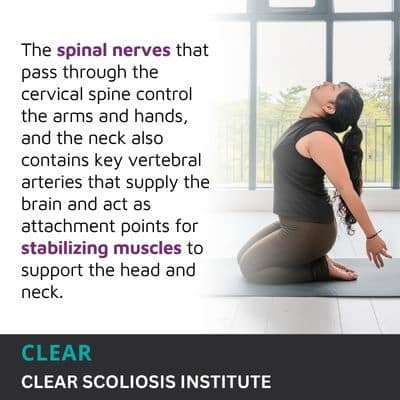
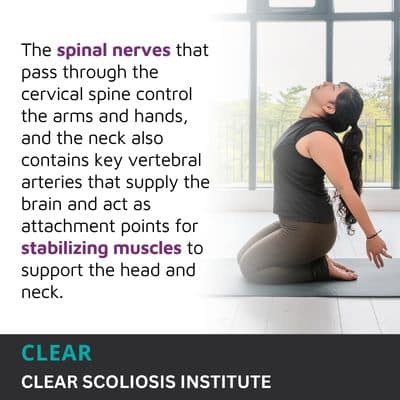 The spinal nerves that pass through the cervical spine control the arms and hands, and the neck also contains key vertebral arteries that supply the brain and act as attachment points for stabilizing muscles to support the head and neck.
Cervical instability can disrupt the neck’s ability to support the weight of the head and cause the development of forward head posture.
As the first spinal section, the cervical spine acts as the bridge between the brain, the spinal sections below, and the rest of the body.
Cervical Subluxation
Joints are structural points where bones meet, and a subluxation means the vertebrae have become partially dislocated; they are still connected but are misaligned.
The smooth gliding motion of joints in the spine supports even wear and tear, healthy posture and movement patterns.
It’s important to protect the cervical spine’s healthy alignment and lordosis to facilitate its strength and flexibility.
Symptoms of Cervical Subluxation
If vertebrae in the cervical spine have become misaligned, watching for signs that the neck’s balance is disrupted is important; a common response is for the head to shift forward to compensate, causing the development of forward head posture that increases the weight of the head on the neck, further straining its vertebrae, supportive structures, and muscles.
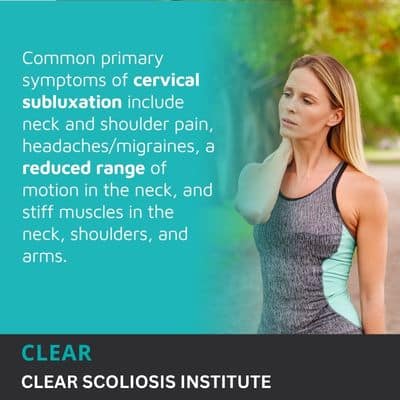 Common primary symptoms of cervical subluxation include neck and shoulder pain, headaches/migraines, a reduced range of motion in the neck, and stiff muscles in the neck, shoulders, and arms.
Sharp pain in the neck and upper back are common and neck movement can be accompanied by a grinding sensation, instead of smooth gliding joint motion. A loss of mobility in the neck can make it difficult to turn the head and look over the shoulder.
Headaches and migraines can develop due to muscle tension and/or reduced blood flow to the area.
Secondary symptoms of cervical subluxation depend on the degree of nerve irritation and can involve fatigue, dizziness, numbness, and tingling sensations in the arms, hands, and fingers.
Cervicogenic dizziness can develop due to a disruption in communication between the brain and the neck’s sensory receptors that confuse the vestibular system.
A misalignment in the upper cervical vertebrae, in particular, is associated with a disruption in proprioception (the body’s sense of location/position without visual cues); the upper cervical spine contains a number of sensors that help orient the head in space, and subluxation causes the sensors to send incorrect information.
Causes of Cervical Subluxation
Symptoms of cervical subluxation can vary based on the underlying cause, and common causes include trauma/injury, chronic poor posture, spinal degeneration, or the presence of an underlying condition such as Ehlers Danlos Syndrome or scoliosis.
Physical Trauma
The most common cause of cervical subluxation is physical trauma such as car accidents, falls, or sports injuries.
The force of direct impact on the cervical spine can result in a subluxation as vertebrae are pushed beyond their natural range of motion.
Poor Posture
Chronic poor posture can alter the neck’s alignment over time by exposing the cervical spine and its supportive muscles and ligaments to uneven pressure.
Not practicing proper and safe lifting of heavy objects repeatedly can also strain the neck and its surrounding supportive structures.
Degenerative Changes
Spinal degeneration is a contributing factor in the development of a number of spinal injuries and conditions. Most degenerative changes in the spine involve degenerative disk disease.
If one or more discs are degenerating in the neck, their ability to provide cushioning, structural support, and flexibility for head movement can be disrupted, and this can cause a shift in the position of adjacent vertebrae attached, causing a subluxation.
Connective Tissue Disorders
There are conditions such as Ehlers Danlos Syndrome, a genetic connective tissue disorder, that causes joint hypermobility and tissue fragility.
As bones and joints need support from strong surrounding muscles, ligaments, and connective tissues, if an underlying condition weakens supportive structures, joint instability and subluxation can occur.
Scoliosis
A spinal condition like scoliosis causes a loss of the spine’s healthy curves and alignment and can develop in the cervical spine; in these cases, the neck develops an unnatural lateral curve, and the rotational component causes certain vertebral bodies to twist, further misaligning the spine.
It’s also not uncommon for lumbar scoliosis to cause a compensatory curve to develop in the cervical spine in an attempt to re-balance the spine from the top.
Scoliosis can also contribute to a cervical subluxation through impacting the cervical spine’s surrounding muscles and supportive structures; scoliosis is associated with muscular imbalance that can cause a lack of support and contribute to weaker joints that are more vulnerable to dislocations.
Here at the Atl anta Scoliosis Center, symptoms and potential complications of scoliosis are minimized through a proactive treatment response that works towards restoring the spine’s alignment and stability.
Conclusion
Most spinal conditions and injuries are best addressed early with a proactive and customized treatment plan.
A cervical subluxation is a partial dislocation of a vertebra in the neck, meaning it has shifted out of alignment with the rest of the vertebrae and most commonly occurs in the upper cervical spine.
Symptoms of cervical subluxation can include headaches, migraines, tiredness, neck and shoulder pain, dizziness, changes to proprioception, a reduced range of motion in the neck, and radiating pain felt in the arms, hands, and fingers.
If the cervical spine is unstable due to a subluxation, it can interrupt communication between the brain, the spine, and the rest of the body, and if the spine is misaligned, it can further disrupt the body’s overall symmetry.
Causes of cervical subluxation include injury, poor posture, degenerative disk disease, Ehlers Danlos Syndrome, and scoliosis.
When it comes to addressing a cervical subluxation with treatment, plans are customized around the underlying cause of the misalignment but can include chiropractic adjustments, physical therapy, and the use of a back brace.
Chiropractic adjustments can work towards improving the position of a misaligned vertebral body in relation to the other vertebrae, and physical therapy can work towards improving posture and support by increasing the strength and balance of the area’s surrounding muscles.
Physical therapy and rehabilitative exercise can also help improve disc health by increasing circulation and blood flow around an affected disc.
Bracing can help by holding the torso and spine in a straight and aligned posture, and while the spine’s position is being maintained, the brain is getting used to supporting the change for neurological retraining and postural restoration.
The post Cervical Subluxation Symptoms: What to Watch For appeared first on Atl anta Scoliosis Center.