
Back pain is the leading disability around the world and can disrupt mobility and quality of life. Leading a spine-friendly lifestyle can preserve spinal health and function, and regular exercise and stretching can slow natural age-related spinal degeneration.
Decompressing the spine offers a number of benefits. Spinal decompression is a traction-based therapy that creates negative pressure to relieve compression, pain, and improve disc health. Decompression exercises can help elongate the spine and improve its flexibility.
Helpful decompression exercises for back-pain relief include the full hang, the Cat-Cow stretch, and the Child’s pose.
Spinal Decompression
Decompressing the spine reduces pressure on the spine and its supportive structures including its surrounding muscles, ligaments, vertebrae, spinal nerves, and intervertebral discs.
 Decompression is gentle stretching that elongates the spine to maintain flexibility, strength, and pain-free movement.
The spine consists of 24 articulating vertebrae (bones) that are separated by an intervertebral disc, and overall spinal health is shaped by disc health.
Decompression can improve disc health by relieving pressure and increasing circulation and blood flow.
Disc Health
The discs consist of two main structures: a soft interior nucleus surrounded by a tough but flexible outer annulus and sit between adjacent vertebral bodies.
The discs perform many essential functions from acting as the spine’s shock absorbers to prevent friction during movement.
Adjacent vertebral bodies attach to the disc in between, facilitating the spine’s structure and alignment. The discs also combine forces to maintain the spine’s flexibility.
Disc hydration is a key factor. As we age, the discs lose fluid, becoming thinner and more brittle; this develops over time, and excessive fluid loss can disrupt a disc’s strength and ability to absorb shock.
If a disc changes shape due to degenerative changes, it can also affect the position of adjacent vertebrae attached and contribute to uneven wear and tear and spinal misalignment.
Most spinal degeneration starts with the discs, so maintaining disc health can preserve spinal health and function and decelerate natural degenerative changes in the spine.
Because the discs are largely avascular, they are slow to heal and need to absorb oxygen and nutrients from their surroundings; regular movement and pressure changes are needed for increasing circulation and blood flow to maintain disc hydration and health, and regular decompression therapy offers these potential benefits.
The design of the spine is based on movement, so gentle stretches can help maintain spinal flexibility and relieve pressure on the discs for improved circulation and pain relief.
Nerve Health
One of the spine’s primary roles of the spinal column is to protect the spinal cord within. The spinal cord consists of 31 pairs of spinal nerves that coordinate with the brain to form the body’s central nervous system (CNS).
As the body’s vast communication network, central nervous system health is key to overall health.
The spinal nerves pass through the spinal cord and exit the spine at various locations, branching off in different directions throughout the body.
If a spinal nerve is experiencing uneven pressure due to disc degeneration or compression caused by another source, the nerve can cause pain and discomfort felt anywhere along its pathway.
Nerve-related back pain can be severe and difficult to diagnose as pain can be felt far from the site of the affected nerve. If a nerve is compressed, it can become inflamed due to less room to function within, and this can cause a number of issues determined by the type of nerve and its location.
Decompression can open up space within the spine so nerves can function optimally and relieve pressure on impinged nerves for pain relief.
Back Pain and Decompression Exercises
People can experience back pain for a number of reasons including spinal rigidity, lack of support, poor posture, nerve compression, and muscular imbalance.
No decompression therapy should be attempted to remedy back pain before identifying the underlying cause of the pain to ensure decompression therapy won’t exacerbate symptoms or further strain the spine.
Common decompression exercises recommended for pain relief include hanging from a pull-up bar, the Cat-Cow stretch, and the Child’s pose.
Hanging from a Pull Up Bar
The simplest decompression stretch involves hanging from a bar with no support so the weight of the body is stretching the spine, increasing space within the spine, and taking pressure off its structures.
Hanging uses gravity to elongate the spine and creates negative pressure to relieve pressure on discs, nerves, and supportive structures.
To perform a full hang for spinal decompression, ensure a pull-up bar is secure and use an overhand grip to grasp the bar firmly while engaging the shoulders and lifting the feet off the ground so the body is suspended and the spine is being stretched.
Hanging from a pull-up bar can relieve pressure and provide short-term pain relief caused by compressed nerves.
Cat-Cow Stretch
The Cat-Cow stretch can help relieve tension and increase the spine’s flexibility for an improved range of motion.
The stretch focuses on targeted movement and breathing. The starting position is on the hands and knees and involves repeatedly and slowly alternating between arching the back (cow position) and rounding the spine (cat position).
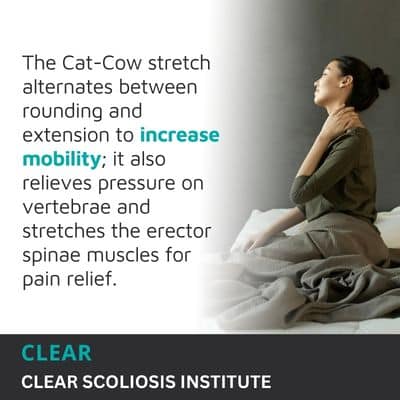 The Cat-Cow stretch alternates between rounding and extension to increase mobility; it also relieves pressure on vertebrae and stretches the erector spinae muscles for pain relief.
It can also provide pain relief and improve mobility by opening up the hip flexors and mobilizing joints, and gentle rhythmic breathing while switching poses further stretches the neck and spine.
Spinal health and postural health are connected, and the principles of mindful movement and breathing are important for postural awareness and restoration.
Child’s Pose Stretch
The Child’s pose is a commonly-recommended stretch for its ability to decompress the lumbar spine and hip area.
The starting position is on the hands and knees. Then slowly sit the buttocks on heels of the feet while extending the arms forward on the floor to deepen the stretch.
Holding the pose and breathing deeply into the lumbar spine can lengthen the vertebrae of the lower back and create space.
The weight-shift onto the back of the heels opens up the facet joints and discs of the lumbar spine and provides relief from long periods of sitting or standing.
The pose also stretches the erector spinae muscles that can become stiff and painful, and spreading the knees encourages hip rotation to release tension from sore and stiff hips.
Hip health and mobility is key to healthy lower-body movement patterns and even weight distribution over the lower body.
Conclusion
Exercises for spinal decompression should be approved by a medical professional, particularly if the source of pain hasn’t been identified or a spinal condition is involved.
Regular decompression exercises like hanging from a pull-up bar, the Cat-Cow stretch, and the Child’s pose can help maintain a spine-friendly lifestyle through increasing spinal flexibility and relieving tension on the vertebrae, discs, spinal nerves, and the spine’s supportive structures.
Decompression uses gravity to gently stretch the spine and its surroundings, and if back pain is caused by muscle tension, compressed nerves, or degenerating discs, it can help by relieving pressure and creating space within the spine for the discs and nerves to function optimally.
Decompression also supports healthy movement patterns by maintaining spinal flexibility, and mindful movement and posture is key to long-term spinal health and function.
When it comes to back pain, it’s important to understand the difference between addressing pain as a symptom, or the cause of pain. For long-term pain relief, the underlying cause of back pain needs to be identified and addressed, so comprehensive assessment is needed, often accompanied by X-ray imaging to see what’s happening in and around the spine.
Here at the Atl anta Scoliosis Center, the first step to improving a patient’s back pain is determining its underlying cause and customizing a treatment plan accordingly.
The post Best Spine Decompression Exercises for Back Relief appeared first on Atl anta Scoliosis Center.